|
| Witches market Sucre |
 |
| Morning bus ride |
 |
| Citronella which we used for tea |
 |
| Devils throat in Maragua |
 |
| Often clouds in the morning |
 |
| The geology on this trek changes every few hours |
 |
| Silica is seen frequently on the hike, harder is some parts and crumbly in others |
 |
| First view of the crater Maragua with the Andes in the background |
 |
| Many water balloons for Carvnival |
 |
| Stars in Icla, I have seen so many shooting stars here |
 |
| Membrillo, or quince in English, one of the many fruits we ate in Icla. We had fresh figs, prickly pear cactus, oranges, peaches, grapes, apples and other from the trees. |
 |
| An owl watching us hike out of the crater. I have also seen viscachua (like a hare) and a snake on other trips. As well as lots of loros. |
 |
| A wasp carrying a spider back to its nest |
 |
| Kantuta is the national flower of Bolivia. The flower looks likes this and is red, yellow and green. |
 |
| Quinoa |
 |
| An adventurous bus ride in the morning to the hike after a night of rain |
 |
| We watched this dung beetle roll a piece of dung like a clown using its front legs to walk and hind legs to roll the ball and it would often roll over the ball like a clown. |
 |
| Glad we arrived after this hail storm. The hail was bigger than a quarter. |
 |
| My last hike to Maragua |
 |
| Pink potatos.. papas lisa. They are even pink on the inside when cooked. Yummy |
 |
| Not sure how this bird was able to fly so graceful with a tear in its wing |
 |
| dragon fly (Libelula) |
 |
| Absolutely beautiful after a bit of rain cleared |
 |
| Icla |
 |
| The girls found some mud in Icla... |
 |
| Dinosaur footprints |
 |
| The patterns of the crater manage to impress me every visit. |
 |
| Many hikes through corn and other fields. |
 |
| Enjoyed many a lunch by these waterfalls |
 |
| Since its rainy season the rivers were muddy but were clearing up by my last hike |
 |
| So many flowers were in bloom, each hike different flowers were blooming |
 |
| The Inca trail in Chaunaca |
 |
| Cave paintings |
 |
| habas, fava bean |
 |
| Dinosaur footprints |
 |
| Cicada (cigarra) |
 |
| Plant for stomach aches munya |
 |
| Went to see the performance 20 year of Cueca at Teatro Mariscal the oldest theatre in Sucre. |
 |
| Controversial statue in Tarabuco of a soldier of the battle jumbate taking the heart of a spaniard |
 |
| fossils proving that the area was once under water |
 |
| In pusilli the mother crushed the wheat for our soup on this stone (batan). (The peppers are ready to be crushed for llajua - salsa picante) |
 |
| More quinoa |
Pujllay Festival in March, 2012
We were almost hit by the Presidents car because it was going down a really crowded street and we couldnt get out of the way and we couldnt figure out who the person in the car dressed up was until someone told us to move out of the presidents way.
 |
| Pujllay which means to play in Quechua |
 |
| Pukara (fortress) in Pujllay |
 |
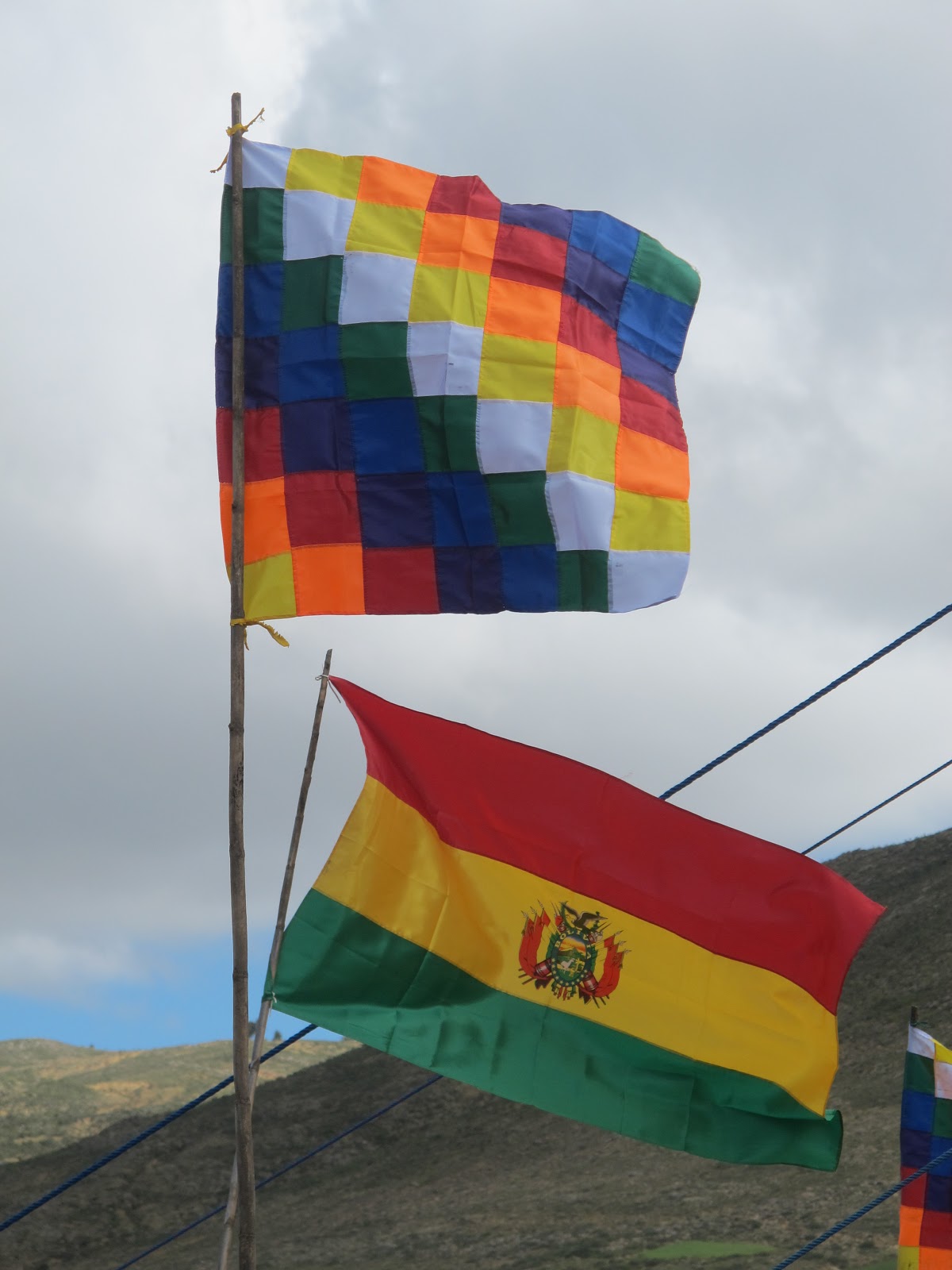
| The flag of Bolivia on the bottom and the whiphala flag of the west of Bolivia |
 |
| These made a wonderful sound when the stamped their feet as the spurs would clang together |
The following are more trek photos.
Sucre and Volunteering
Well my time in Bolivia and Sucre came to an end faster than I would have liked. But volunteering in Sucre was a highlight. Though I spent some time volunteering with different organizations my favorite was Condor Trekkers (
http://www.condortrekkers.org/). A nonprofit ecofriendly trekking agency. The treks were amazing, the guides were awesome and the food was delicious.
Sucre offers so many volunteer opportunites. It has has lots of orphanages which need help, as well as volunteering with handicapped children and so many others but one of the other organization that I had the most fun with was Inti. Its a magazine for children who work jobs afterschool such as shining shoes or selling bird seed for very little money. The magazine is sold by the children and they get to keep half of the profits and often their drawings or pictures are in the magazine so it gives them something to be proud of. I walked around with some of the girls to help them try to sell the magazine. Although I am not much of a salesperson I found it a really interesting experience to see peoples reactions. The children targeted tourists and I could explain in English to the tourists what the magazine was because the children cannot speak English but the vast majority of people who bought the magazine were locals which surprised me. I actually found it fun trying to explain to many very curious Bolivians why a foreigner was walking around with a local girl, as we received many stares and questions. Some of the girls were really little and wouldnt even talk to anyone would just hold out the magazine.. One of the girls was so little she spent more time dropping the magazine and I am not sure she could even speak much Spanish. So I would normally tell the younger ones to speak up and to talk and say hello and have confidence or they just get ignored when they would quietly ask ¨magazine?¨ or just hold up the magazine. Inti brought the kids out on an excursion to a place in the countryside for Easter and had a picnic played some games and had an Easter egg hunt which is not common in Bolivia.
Sucre
Sucre is the capital of Bolivia. It called the city of crazies because it has the first and only mental institute in the country.